WISHING YOU A TRILLING TIME
THIS HALLOWEEN!!!

17.10.11

14.10.11

12.10.11


4.10.11
~Dierendag!

Veel dierenliefhebbers zetten op 4 oktober
hun huisdier in het zonnetje.
Geven hem of haar een extra bot, lange wandeling
of bijvoorbeeld dierensnoepje.
Omdat het dierendag is.
In Nederland wordt dierendag sinds 1930 gevierd.
Deze dag is niet lukraak gekozen.
Tijdens een internationaal Dierenbeschermingscongres
in 1929 in Wenen werd besloten de sterfdag van de
heilige Franciscus van Assisi tot
Werelddierendag uit te roepen.

Franciscus van Assisi (1181-1226) stichtte in zijn
tijd de kloosterorde van de Franciscanen of Minderbroeders.
Volgens de legendes predikte Van Assisi niet alleen
onder mensen maar ook onder dieren en voerde hij
vele gesprekken met de leden van het dierenrijk.
In verschillende landen in de wereld kunnen gelovigen
op 4 oktober met hun dieren in de kerk terecht
om hen te laten zegenen. Tegenwoordig is
Dierendag al lang niet meer alleen
een christelijk feest.

World Animal Day is celebrated each year on October 4.
It started in Florence, Italy in 1930 at a convention of
ecologists.On this day, animal life in all its forms
is celebrated, and special events are planned on
locations all over the globe. 4 October was originally
chosen for World Animal Day because it is the feast
day of Francis of Assisi, a nature lover and patron saint
of animals and the environment.
Numerous churches throughout the world observe
the Sunday closest to 4 October with a
Blessing for the Animals.

2.10.11

Art by Arthur Rackham
The rainbow inspires metaphor and simile.
Virginia Woolf in To the Lighthouse highlights the
transience of life and Man's mortality through
Mrs Ramsey's thought,
- "it was all as ephemeral as a rainbow"
Wordsworth's 1802 poem "My Heart Leaps Up" begins:
- My heart leaps up when I behold
- A rainbow in the sky:
-
- So was it when my life began;
- So is it now I am a man;
- So be it when I shall grow old,
- Or let me die!...
-
The Newtonian deconstruction of the rainbow
is said to have provoked John Keats to lament
in his 1820 poem "Lamia":
- Do not all charms fly
- At the mere touch of cold philosophy?
- There was an awful rainbow once in heaven:
- We know her woof, her texture; she is given
- In the dull catalogue of common things.
- Philosophy will clip an Angel's wings,
- Conquer all mysteries by rule and line,
- Empty the haunted air, and gnomed mine –
- Unweave a rainbow
READ MORE ABOUT RAINBOWS HERE!!!
yOU ALL
have a
whimsical
sunday!!!
21.9.11

May all of our hearts beat so wild and free...
if only for the day.


Credits:
All photos are the work of Irene Suchocki
WEBSITE HERE!

19.9.11
~Stealing it’s Lunch….

A young Rattus Norvegicus
(better known as the brown rat)
helps himself to the lunch of a 12-year-old
African leopard named Sheena
at the Santago Rare Leopard Project in
Hertfordshire, England.
Sheena gives the little dinner thief a sniff
and goes back about her leopard business.
Read Full story HERE!


13.9.11
~Old Illustration

A Bracket Fungus (Polyporus varius) -
groups of fruiting bodies with one sectioned.
Watercolour by G. Harding, 1900
.
11.9.11
~Mermaids

A mermaid is a mythological aquatic creature
with a female human head, arms, and torso and the
tail of a fish. A male version of a mermaid is known
as a "merman" and in general both males and females
are known as "merfolk".
Mermaids are represented in the folklore,
literature and popular culture of
many countries worldwide.

The first known mermaid stories appeared
in Assyria, ca. 1000 BC. The goddess Atargatis,
mother of Assyrian queen Semiramis, loved a mortal
shepherd and unintentionally killed him. Ashamed,
she jumped into a lake to take the form of a fish,
but the waters would not conceal her divine beauty.
Thereafter, she took the form of a mermaid—human
above the waist, fish below—though the earliest
representations of Atargatis showed her as a fish
with a human head and legs, similar to the Babylonian Ea.
The Greeks recognized Atargatis under the name Derketo.
Prior to 546 BC, the Milesian philosopher Anaximander
proposed that mankind had sprung from an aquatic
species of animal. He thought that humans, with their
extended infancy, could not have survived otherwise.
READ MORE HERE!!!

art by John William Waterhouse
8.9.11
~This is a true story
of Mother’s Sacrifice during the
China Earthquake.
After the Earthquake had subsided, when the
rescuers reached the ruins of a young woman’s house,
they saw her dead body through the cracks.
But her pose was somehow strange that she knelt on
her knees like a person was worshiping; her body
was leaning forward, and her two hands were
supporting by an object.
The collapsed house had crashed her back and her head.
With so many difficulties, the leader of the rescuer
team put his hand through a narrow gap on the wall
to reach the woman’s body. He was hoping that this
woman could be still alive. However,
the cold and stiff body told him that
she had passed away for sure.

He and the rest of the team left this house and
were going to search the next collapsed building.
For some reasons, the team leader was driven by
a compelling force to go back to the ruin house
of the dead woman. Again, he knelt down and used
his had through the narrow cracks to search the little
space under the dead body. Suddenly, he screamed with excitement,” A child! There is a child! “
The whole team worked together; carefully they removed
the piles of ruined objects around the dead woman.
There was a 3 months old little boy wrapped in a
flowery blanket under his mother’s dead body.
Obviously, the woman had made an ultimate sacrifice
for saving her son. When her house was falling,
she used her body to make a cover to protect her son.
The little boy was still sleeping peacefully when
the team leader picked him up.
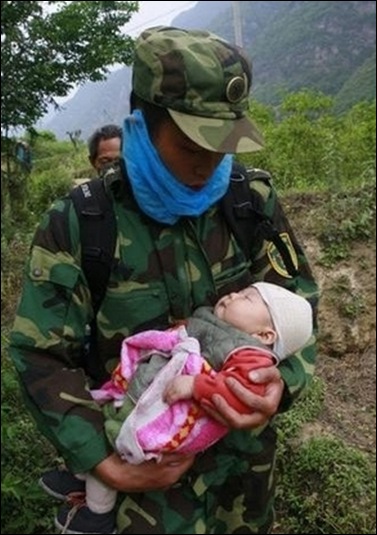
The medical doctor came quickly to exam the
little boy. After he opened the blanket, he saw a cell phone
inside the blanket. There was a text message on the
screen. It said,” If you can survive, you must remember
that I love you.” This cell phone was passing
around from one hand to another.
Every body that read the message wept.
” If you can survive, you must remember that I love you.”
Such is the mother’s love for her child!!

Abonneren op:
Posts (Atom)